Given an m x n matrix, return true if the matrix is Toeplitz. Otherwise, return false.
A matrix is Toeplitz if every diagonal from top-left to bottom-right has the same elements.
Example 1:
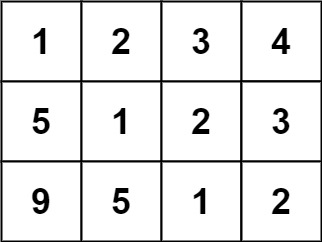
Input: matrix = [[1,2,3,4],[5,1,2,3],[9,5,1,2]]
Output: true
Explanation:
In the above grid, the diagonals are:
"[9]", "[5, 5]", "[1, 1, 1]", "[2, 2, 2]", "[3, 3]", "[4]".
In each diagonal all elements are the same, so the answer is True.
Example 2:
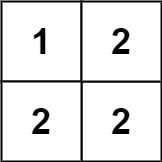
Input: matrix = [[1,2],[2,2]]
Output: false
Explanation:
The diagonal "[1, 2]" has different elements.
Constraints:
m == matrix.lengthn == matrix[i].length1 <= m, n <= 200 <= matrix[i][j] <= 99
Follow up:
- What if the
matrixis stored on disk, and the memory is limited such that you can only load at most one row of the matrix into the memory at once? - What if the
matrixis so large that you can only load up a partial row into the memory at once?
Solution:
class Solution {
    public boolean isToeplitzMatrix(int[][] matrix) {
        int lenRow = matrix[0].length;
        int len = matrix.length;
        int match;
        int  j =0;
        int k;
        int start = 0;
        int l=0;


         while(l<lenRow-1){
             k = 0;
             j = l;
             l++;
             match= matrix[k][j];

            while(k<matrix.length-1 && j<lenRow-1){
                k++;
                j++;
                if(matrix[k][j] != match) return false;
            }
        }

        l = 0;
        while(l<matrix.length-1){
             k = l;
             j = 0;
             l++;
             match= matrix[k][j];

            while(k<matrix.length-1 && j<lenRow-1){
                k++;
                j++;
                if(matrix[k][j] != match) return false;
            }
        }


        return true;
    }
}
Approach:
A Toeplitz matrix is a matrix where every diagonal from top-left to bottom-right has the same elements.
Example:
1 2 3 4
5 1 2 3
9 5 1 2
Every diagonal (1-1-1, 2-2-2, 3-3, 4) contains identical elements → Toeplitz.
You want to check all diagonals of the matrix to ensure all elements on each diagonal are the same.
Step 1: Get matrix dimensions
int lenRow = matrix[0].length;  // number of columns
int len = matrix.length;        // number of rows
Step 2: Check diagonals starting from the top row
int l = 0;

while(l < lenRow - 1) {  // iterate over each column except the last one
    k = 0;               // start row
    j = l;               // start column
    l++;                 // move to next diagonal start
    match = matrix[k][j]; // value to match along the diagonal

    while(k < matrix.length - 1 && j < lenRow - 1) {
        k++; j++;
        if(matrix[k][j] != match) return false; // if mismatch, not Toeplitz
    }
}
- Idea: For each diagonal starting at
(0, l)(top row), move down-right(k++, j++)and check all elements. - Stop when you reach the last row or last column.
Step 3: Check diagonals starting from the first column (except top-left)
l = 0;
while(l < matrix.length - 1) {  // iterate over each row except the last one
    k = l;     // start row
    j = 0;     // first column
    l++;
    match = matrix[k][j];  // value to match along the diagonal

    while(k < matrix.length - 1 && j < lenRow - 1) {
        k++; j++;
        if(matrix[k][j] != match) return false;
    }
}
- Idea: For diagonals starting in the first column
(l, 0), check all down-right elements. - This covers diagonals not starting in the top row.
Step 4: If no mismatches found
return true;
- If all diagonals have matching elements → matrix is Toeplitz.
✅ Key Points
- Two sets of diagonals:
- Starting from top row
- Starting from first column
This ensures all diagonals are checked without repeating the top-left diagonal.
- Time Complexity:
O(m * n)- Every element is visited exactly once on its diagonal.
- Space Complexity:
O(1)- No extra storage needed (only pointers
k, j, match).
- No extra storage needed (only pointers